How to Say Dates Out Loud in English
The same written date is said five different ways. Here is every spoken form, and the ordinal pairs that cost people appointments.
Most guides to English dates teach you how to write them. This one is about what comes out of a speaker's mouth, which is a different problem. A date written 01/09/2026 is said four or five different ways depending on who is talking, and almost none of those ways match the digits on the page. If you have ever written down the wrong appointment after a phone call, this is why.
The gap between writing and saying
Take a single written date: 1 September 2026. Here is what you might actually hear:
- "the first of September twenty twenty-six" — British, full
- "September first, two thousand twenty-six" — American, full
- "the first of September" — British, year dropped
- "September the first" — British, month first
- "the first" — everything dropped, context carries it
Every one of those is the same date. The written form gives you no clue which you will get.
British: day before month
The standard British spoken form puts the day first, wrapped in "the" and "of":
- 3 July = "the third of July"
- 21 March = "the twenty-first of March"
- 30 November = "the thirtieth of November"
British speakers also say "July the third", moving the month to the front but keeping "the". Both are common and neither sounds formal.
American: month before day
American English puts the month first and usually drops both "the" and "of":
- July 3 = "July third"
- March 21 = "March twenty-first"
- November 30 = "November thirtieth"
Notice that the day is still an ordinal — "July third", never "July three" — even though it is written as a plain digit. The ordinal is audible even when it is invisible on the page.
The listening problem: you cannot wait
When you read a date you can look at the whole thing at once. When you hear one, the first thing you hear is either a day or a month, and you do not yet know which. "The third of..." commits to British order. "July the..." commits to nothing yet. You have to hold the first element in memory until the second one arrives.
This is why learners who can read dates perfectly still lose them in speech. It is not vocabulary — it is a short-term memory task under time pressure, and it only improves with repetition.
Ordinals: where dates actually go wrong
Days are spoken as ordinals, and several pairs are nearly identical at conversational speed:
| Confusable pair | What separates them |
|---|---|
| 13th / 30th | Stress: thir-TEENTH vs THIR-tieth |
| 14th / 40th | Stress: four-TEENTH vs FOR-tieth |
| 15th / 50th | Stress: fif-TEENTH vs FIF-tieth |
Only the first two matter for dates, since no month has a fiftieth — but the same stress pattern runs through all English numbers, so drilling it on dates pays off everywhere. The rule: the "-teen" form pushes stress to the end, the "-ty" form keeps it at the front.
A few ordinals are irregular and simply have to be learned: first, second, third, fifth, eighth, ninth, twelfth, and anything ending in those — twenty-first, thirty-first. The full number names from 1 to 100 cover the patterns these come from.
Dropping the year, and dropping everything
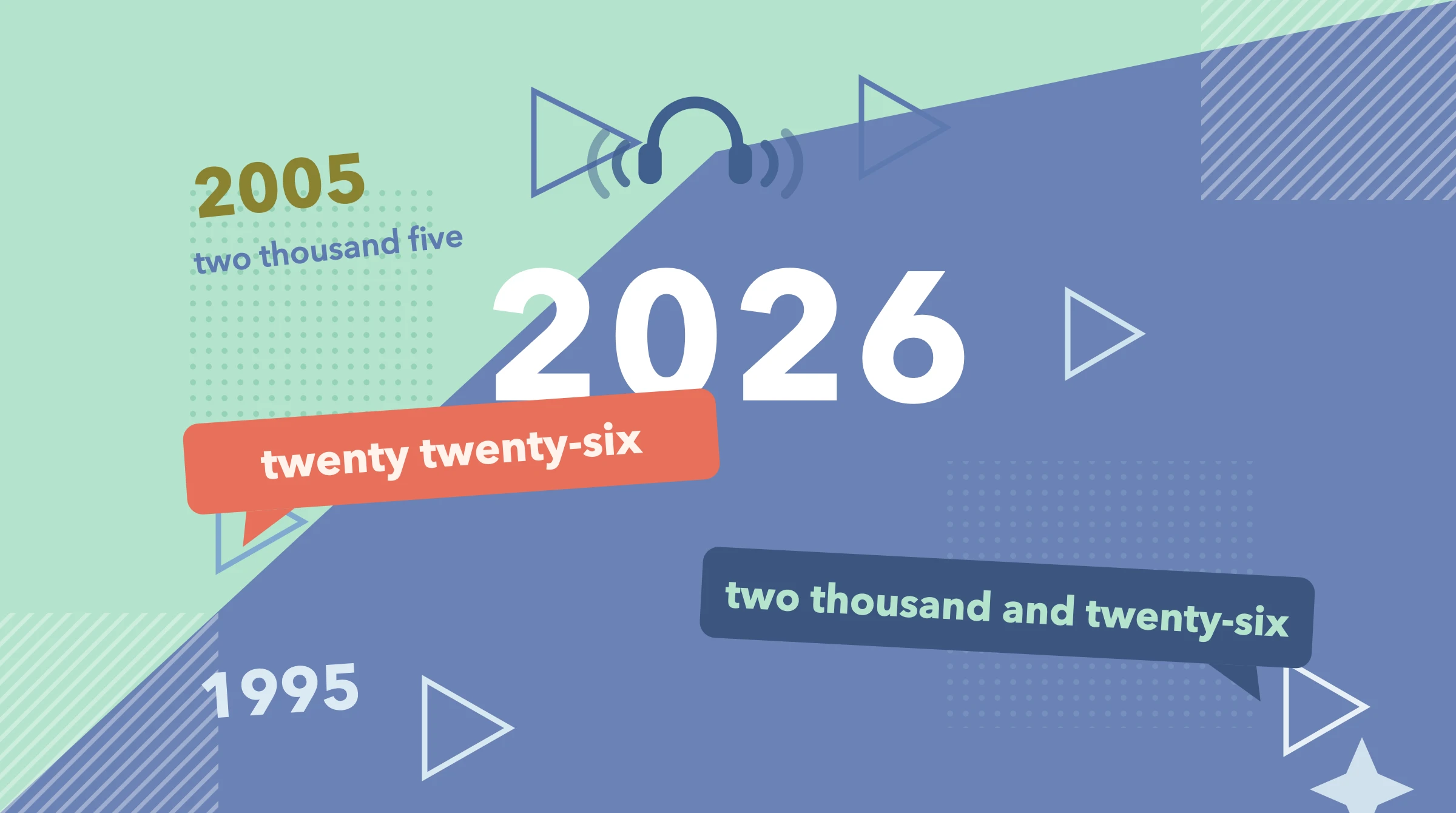
In real conversation the year usually disappears, because both speakers know it. "The meeting's on the twelfth" is a complete date if you are both looking at the same month. When the year does appear, it follows the day and month and has its own spoken forms — 2026 is either "twenty twenty-six" or "two thousand and twenty-six", covered in how to say years in English.
You will also meet relative dates that never touch a number at all: "a week on Tuesday", "the Friday after next", "this time next month". These are the hardest to catch because there is no digit to grab onto.
How a written date becomes a spoken one
| Written | British spoken | American spoken |
|---|---|---|
| 01/09/2026 | the first of September twenty twenty-six | January ninth, two thousand twenty-six |
| 3 July | the third of July | July third |
| 22 Feb 1998 | the twenty-second of February nineteen ninety-eight | February twenty-second, nineteen ninety-eight |
The first row is the one to stare at. 01/09/2026 is the first of September to a British speaker and the ninth of January to an American one — the same six digits, two different days, nine months apart. When the stakes matter, say the month by name.
Training the reflex
Reading about these patterns gets you to recognition. Catching them at speed takes drilling, because the decision has to happen faster than conscious thought. Focused dictation works best: hear a date, type what you heard, check it, repeat — with British and American forms mixed randomly so you train the "which order is this" reflex rather than one fixed pattern.
That is what date listening practice on Numblr is built for, including the ordinal pairs above and the years that go with them.