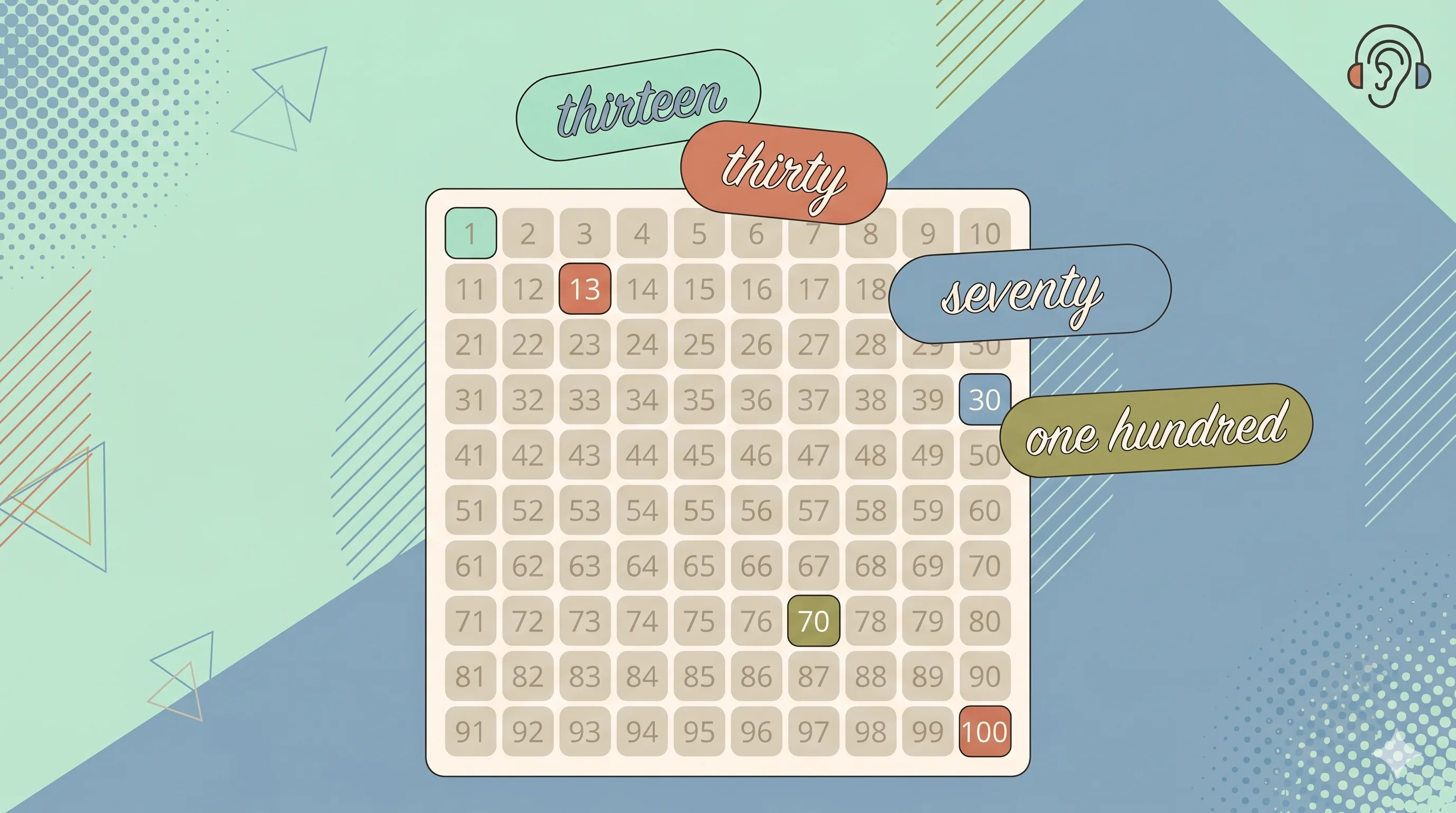
An Introduction to English Numbers: How They Sound and How to Hear Them
Learn English numbers from 0 to 100 and how they sound in spoken English. Understand the teen vs. ty confusion, stress patterns, and real-life listening tips.
English numbers seem simple when you read them on a page: 1, 2, 3. But hearing them in real conversation is a different story. Numbers fly by quickly, many sound alike, and you usually get only one chance to catch them. This guide introduces the English number system and shows you what to listen for when numbers are spoken aloud.
The Three Types of English Numbers
Before we talk about how numbers sound, let us cover the three main types you will encounter:
- Cardinal Numbers — Used for counting: one, two, three, four. These are the most common and the ones you will hear most often in daily life.
- Ordinal Numbers — Describe position: first, second, third, fourth. You hear these in dates ("the third of March"), floors ("the fifth floor"), and rankings ("she finished second").
- Nominal Numbers — Used as labels, not for counting: bus number 5, room 302, flight 7-7-4. These are spoken digit by digit.
Numbers 0-10: The Building Blocks
Every number in English is built from these basic sounds. When you hear larger numbers, your brain breaks them into these pieces:
| Number | Word | What to Listen For |
|---|---|---|
| 0 | Zero | Also said as "oh" in phone numbers and years |
| 1 | One | Starts with a "w" sound: "wun" |
| 2 | Two | Sounds the same as "too" and "to" |
| 3 | Three | The "th" sound is unique — tongue between teeth |
| 4 | Four | Sounds like "for" — rhymes with "door" |
| 5 | Five | The "v" at the end is soft but important |
| 6 | Six | Short and sharp — rhymes with "fix" |
| 7 | Seven | Two syllables: "SEV-en" |
| 8 | Eight | Sounds exactly like "ate" |
| 9 | Nine | Rhymes with "fine" and "line" |
| 10 | Ten | Short — rhymes with "pen" and "hen" |
Numbers 11-19: The Confusing Teens
The "teen" numbers are where listening gets tricky. Each one has a unique name, and many of them sound dangerously similar to the "tens" numbers (30, 40, 50...). This is the single biggest source of number confusion for English learners.
| Number | Word | Often Confused With |
|---|---|---|
| 11 | Eleven | — |
| 12 | Twelve | — |
| 13 | Thirteen | Thirty (30) |
| 14 | Fourteen | Forty (40) |
| 15 | Fifteen | Fifty (50) |
| 16 | Sixteen | Sixty (60) |
| 17 | Seventeen | Seventy (70) |
| 18 | Eighteen | Eighty (80) |
| 19 | Nineteen | Ninety (90) |
The "Teen" vs. "Ty" Problem
This is the most important listening skill for English numbers. If you can master this, you will understand numbers much better in real conversations, on the phone, and in English exams.
The difference is in the stress pattern:
- "Teen" numbers (13-19) have stress on the SECOND syllable: thir-TEEN, four-TEEN, fif-TEEN
- "Ty" numbers (30-90) have stress on the FIRST syllable: THIR-ty, FOR-ty,FIF-ty
In slow, clear speech, you can also hear the final sound: "teen" ends with an "n" sound, while "ty" ends with a quick "ee" sound. But in fast, natural speech, stress is the more reliable clue.
Quick test: If someone says a price and you are not sure if they said "fifteen" or "fifty," ask "One-five or five-oh?" This is a natural way to confirm, and native speakers do it too.
Numbers 20 and Beyond
From 20 onward, English numbers follow a pattern: you combine the tens word with the ones digit. The tens words are:
| Number | Word |
|---|---|
| 20 | Twenty |
| 30 | Thirty |
| 40 | Forty |
| 50 | Fifty |
| 60 | Sixty |
| 70 | Seventy |
| 80 | Eighty |
| 90 | Ninety |
| 100 | One hundred |
For numbers in between, combine the tens word with the ones digit using a hyphen. For example:
- 21 = Twenty-one
- 35 = Thirty-five
- 48 = Forty-eight
- 76 = Seventy-six
- 99 = Ninety-nine
When these are spoken, you will hear a brief pause between the tens and ones parts: "twenty... one," "forty... eight." Learning to hear this rhythm helps you catch two-digit numbers correctly.
Numbers in Real Life: What You Will Hear
Knowing the number words is only part of the challenge. In real conversations, numbers appear in specific patterns:
- Prices: "That is fifteen fifty" means $15.50. Speakers often drop "dollars" or "pounds" if the context is clear.
- Phone numbers: Digits are said one at a time — "oh-four-one-five, double seven, nine-eight-three." The word "double" means a digit is repeated.
- Addresses: "142 King Street" — the number is said as "one forty-two" or "one four two," depending on the speaker.
- Times: "Quarter past three" means 3:15. "Half nine" means 9:30 in British English.
- Years: "Nineteen eighty-four" (1984), "two thousand and twelve" (2012), "twenty twenty-six" (2026).
How to Practice Hearing Numbers
Reading about numbers is a good start, but the real skill comes from listening practice. Here are practical ways to train your ear:
- Number dictation: Ask a friend to read random numbers and write down what you hear. Or use a tool like Numblr that plays numbers automatically and checks your answers.
- Listen to prices while shopping: When you are at a store, try to hear the total before looking at the screen. Were you right?
- Count things in English: Count steps, cars, or items out loud in English. Say the numbers as you go.
- Watch English videos with numbers: Cooking shows (measurements), sports highlights (scores), weather reports (temperatures) — all full of numbers.